Sous-Vide Roast Pork with an Anova
Translated from my original Japanese post (2019). 日本語の原文を読む →
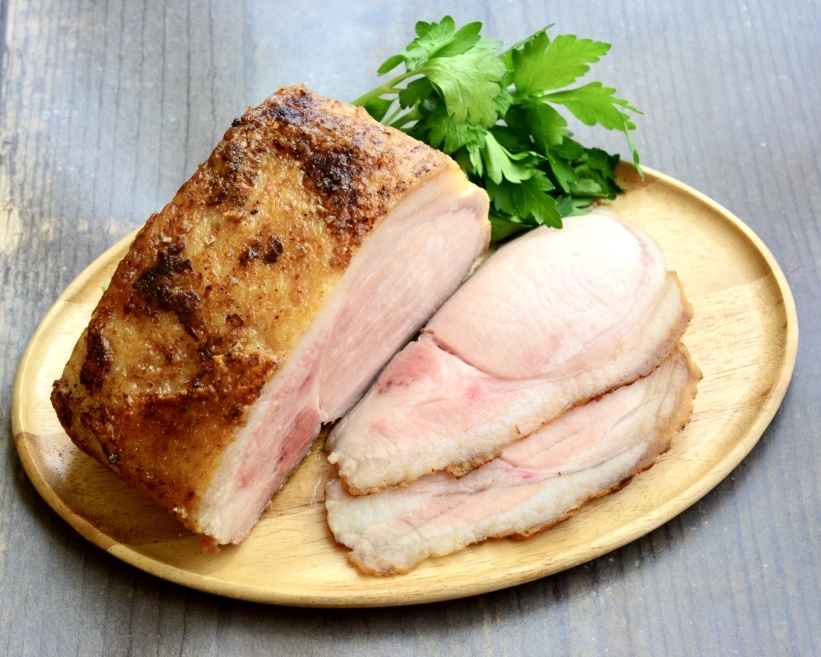
Salut! It's Yoko, your home cook.
For sous-vide, roast pork is just as good a recommendation as roast beef.
Pork is cheaper than beef so it's easy to get hold of, and its light flavor goes well with Japanese food too.
It also feels less like a special-occasion dish than roast beef, so it's easier to make. If you own a sous-vide cooker, I'd say you're missing out if you don't learn this one.
This time I'll show you a style of roast pork where you first heat it through in the Anova and then finish it in the oven or a frying pan.
Roast pork ingredients
The ingredients are very simple.

- Pork loin from Yamagata Prefecture (830 g), which I got through Japan's hometown tax donation program
- Garlic (1 clove)
- Rosemary (fresh gives more aroma, so use fresh if you can)
- Salt and pepper (as needed)
Incidentally, if you add salt at this point at 1% of the meat's weight and let it rest for about two nights, the seasoning goes in nicely.
If that's too much trouble, or if you plan to eat it with a sauce,
a light seasoning is enough, so about 1 tsp is fine.
You can also swap the rosemary for other herbs, or add even more things.
Work out the temperature and time, then into the Anova
First, measure the thickness of the meat. Measure the thickest part, which in most cases is the short side.

The meat I used was 8 cm thick, so I decided to cook it at 60 degrees for 4 hours.
By the way, this post sums up sous-vide temperatures and times.
While the Anova preheats, prepare the pork.
Rub sliced garlic, rosemary, salt, and pepper all over it,

put it in a storage bag, and lower it into water to push the air out.

Once the Anova has finished preheating, plop it into the pot!

If it floats up, put something on top as a weight.

Be careful, though: if the weight is a shape that traps air, that spot ends up touching the meat,
and it won't cook as well there.
Browning in the oven or a frying pan
OK, the pork has finished its 4 hours at 60 degrees.
It's cooked through, so it's ready to eat!
But this time I'm going to brown the surface as well.
Also, if you let the pork rest once, the flavors that have mingled into the juices soak into the meat.
So I let it rest as is in the fridge.
Here it is after resting overnight!

Preheat the oven to 230 degrees C (about 450 F) and...

While it preheats, take the pork out.
The juices can be turned into a gravy sauce, so set them aside here,
and remove the rosemary and garlic since they have an unpleasant texture.

Now poke holes all over the surface of the fat with a fork.
The holes increase the surface area exposed to air, and the rendered fat that melts out fries the fat layer, in effect.

Sprinkle salt on the surface, and when the oven has finished preheating, in goes the pork!

Roast for 1 to 1.5 hours, checking now and then, until the fat is browned.
If you don't want the sides to brown, cover them with aluminum foil like this.
If you're thinking, "Wait, isn't putting it in the oven pointless after sous-vide...?", don't worry.
This is right after roasting, but the temperature at the sides drops quickly.
This is the temperature about 15 seconds after it came out (it's higher right when it comes out).

Also, it started out straight from the fridge, so the inside never gets heated to a high temperature.
I wanted to render a bit more of the fat, so I ended up browning all sides in a frying pan afterward.

If you sear the fat side first, you can cook with the fat that melts out, so no extra oil is needed.
Sizzle it for a few minutes, turning the sides, and... done!
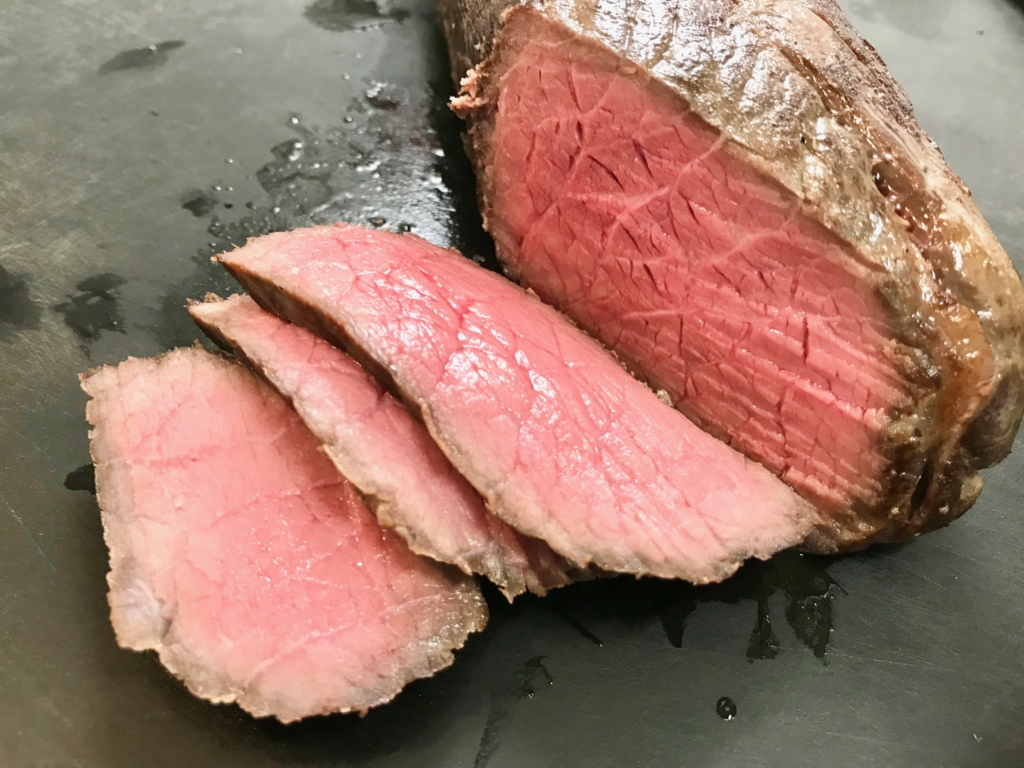
It came out moist and juicy!

What sauce goes with roast pork?
If you add water, salt, pepper, and a little flour to the juices you set aside and stretch them out, you get a gravy sauce.
A pinch of flour is enough to thicken it (add too much and it turns into a bouncy jelly).
If the flavor is lacking, a little bouillon adds depth.
Gravy is handy because you can whip it up quickly.
I also recommend Miya no Tare!
Miya is a steak restaurant chain in places like Tochigi, Aichi, and Gunma, and its sauce is so good that it's sold in stores.
It's an onion-based sauce aged for three weeks, and it's really delicious.
It won a Superior Taste Award from the International Taste Institute in Belgium.
You can sometimes find it near the meat section at supermarkets like Jusco and Ito-Yokado.
So that's how to make sous-vide roast pork!
Once you've made it, you'll get a feel for how long a given thickness takes.
Why not add it to your sous-vide repertoire?
See you next time. Au revoir!