Sous-Vide Temperatures: Food Safety vs. Flavor
Translated from my original Japanese post (2019). 日本語の原文を読む →
Hi! It's Yoko, a home cook.
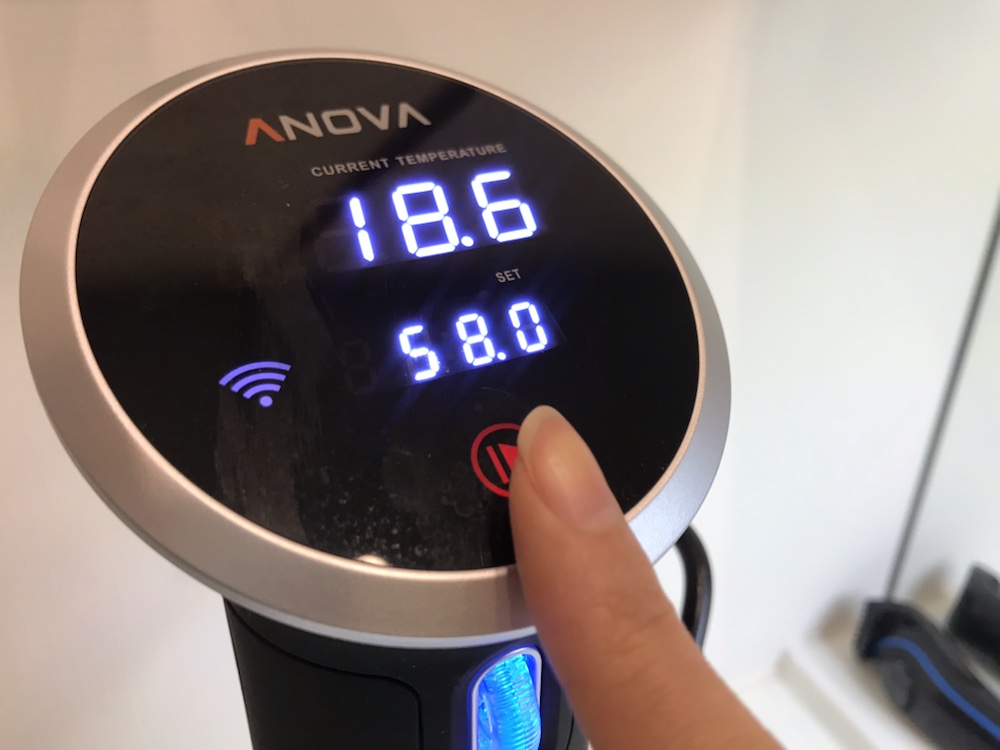
The other day I bought an Anova sous-vide cooker!
As soon as I tried to cook with it, I hit a problem: "What temperature, and for how many hours?"
What worried me most was hygiene, since sous-vide cooks at low temperatures! I don't want a stomachache!
There are lots of recipes out there, but I couldn't tell whether their temperatures and times actually pasteurize the food...
- What temperature should I cook at?
- Is that temperature high enough to kill bacteria?
- Will it taste good?
- How long do I need to keep cooking?
It took me quite a while to look all this up, so I'm leaving it here as a memo.
If you're wondering the same things, I hope it helps!
How to pasteurize with sous-vide
In sous-vide, the lower the temperature, the longer the cooking time.
For safety, I used sources from Japan's Ministry of Health, Labour and Welfare and from the United States, where sous-vide is more advanced.
The Ministry of Health, Labour and Welfare specifies heating meat at 75°C (167°F) for 1 minute, or an equivalent level, to kill bacteria.
Q. To prevent food poisoning from meat, heating the center at 75°C for 1 minute is required. What conditions are equivalent to this?
A. As heat-sterilization conditions equivalent to "75°C, 1 minute," the following are considered reasonable: "70°C, 3 minutes," "69°C, 4 minutes," "68°C, 5 minutes," "67°C, 8 minutes," "66°C, 11 minutes" and "65°C, 15 minutes."
When the cooking temperature is low, as in sous-vide, the time has to be longer to make up for it!
The important thing is that the temperature here means the "core temperature" of the meat.
Imagine it: thin-sliced meat would be fully cooked in 3 minutes at 60°C (140°F).
But a 5 cm-thick (2 in) steak... it's doubtful it would even be cooked through (lol).
So the cooking time has to change with thickness.
Jason Logsdon, who has written books on sous-vide, put together a chart of pasteurization times by thickness of meat, and I translated it.
It's based on sources such as Douglas Baldwin, an authority on sous-vide, and the FDA.
| Type of meat | Chicken, duck and other breast meat | Beef, pork, lamb | |||||
| Thickness and temperature | 58℃ | 60℃ | 63℃ | 65℃ | 55℃ | 57℃ | 60℃ |
| 7cm | 6:00 | 5:00 | 4:15 | 3:45 | 6:30 | 5:15 | 4:00 |
| 6.3cm | 5:20 | 4:25 | 3:35 | 3:10 | 5:40 | 4:35 | 3:35 |
| 5.7cm | 4:50 | 4:05 | 3:10 | 2:55 | 5:10 | 4:00 | 3:05 |
| 5.1cm | 4:15 | 3:20 | 2:30 | 2:20 | 4:30 | 3:20 | 2:30 |
| 4.4cm | 3:45 | 3:00 | 2:15 | 2:00 | 4:00 | 3:00 | 2:15 |
| 3.8cm | 3:10 | 2:30 | 1:55 | 1:40 | 3:25 | 2:25 | 1:55 |
| 3.2cm | 2:55 | 2:10 | 1:40 | 1:25 | 3:10 | 2:05 | 1:40 |
| 2.5cm | 2:15 | 1:35 | 1:15 | 0:55 | 2:45 | 2:00 | 1:30 |
| 1.9cm | 2:00 | 1:20 | 0:50 | 0:40 | 2:30 | 1:45 | 1:15 |
| 1.3cm | 1:50 | 1:10 | 0:35 | 0:25 | 2:10 | 1:25 | 0:50 |
In this chart, 55°C (131°F) is the lowest temperature.
That's because the minimum time needed for pasteurization is 4 hours or more at a core temperature of 54.4°C (130°F), and below that temperature, or with less time, the food won't be pasteurized.
For example, the famous bacteria E. coli and Salmonella don't die unless heated at 55°C for about 10 minutes.
The pasteurization times apply to fish as well as meat, so for things like salmon mi-cuit (about an hour at 40°C to 45°C), which is actually a temperature where bacteria multiply, please use very fresh fish!
Cooling after cooking matters for safety too
Most food poisoning bacteria multiply rapidly at around human body temperature.
In general, most food poisoning bacteria have their optimal growth temperature in the mesophilic range of 25°C to 37°C.
So passing quickly through this temperature range prevents bacteria from multiplying.
- Put the food in only after the water has reached the set temperature
- After cooking, eat right away, or chill it in ice water and reheat just before serving
This extra step lets you enjoy sous-vide more safely.
What temperature makes meat taste best?
"Pasteurization matters, but some dishes like steak don't need to be cooked through. What temperature makes food taste best with sous-vide?"
Yes, a perfectly natural question!
Often the temperatures that don't kill many bacteria taste better...
The short answer: as a rule, 55°C to 65°C (131°F to 149°F).
Douglas Baldwin recommends 55°C for steak and 60°C for chicken breast and pork chops.
I rarely have a use for anything above 60°C. There's a good reason for this,
but to explain it we need to learn a bit about meat.
Understanding what meat is made of
What cut of meat are you cooking?
With sous-vide, the right temperature changes depending on the cut.
That's because the deliciousness of meat is tied to its protein components.
Meat is made of myosin, actin and collagen.
Each of these denatures (changes its properties) with heat, and that changes the texture and flavor!
Endothermic peaks from the thermal denaturation of myosin are clearly detected at 40 to 50°C, and of actin in the 65 to 75°C range. Fish meat behaves in roughly the same way.
Source: Predicting changes in physical properties to optimize cooking (in Japanese)
Basically, sous-vide aims for peak deliciousness by denaturing the myosin and collagen without denaturing the actin.
Myosin begins to denature at 50°C, and the color of the meat gradually changes and it becomes easier to bite through.
Actin is the protein that holds water, and it starts to denature at about 66°C, losing moisture and turning dry.
Collagen gradually begins to turn into gelatin from 51 to 53°C, shrinks from heat at about 65°C, and gelatinization progresses at 70 to 80°C.
(It denatures in two stages with heat.)
So different things denature at different temperatures.
Is the meat you're about to cook full of sinew? Or lean?
Check first.
The collagen problem
Considering the temperatures needed for pasteurization, for lean meat you only need to denature the myosin, so cooking at 55 to 65°C is recommended.
The problem is sinewy meat (meaning lots of collagen)!!
You want to soften the sinew but also keep the lean part moist.
It's a real dilemma how to cook it. It may also depend on your preference.
I wrote that collagen starts to gelatinize at 51 to 53°C, but below 65°C gelatinization barely progresses, so cooking takes forever...
A realistic temperature is 65°C to 70°C (149°F to 158°F).
By the way, above 75 to 80°C gelatinization speeds up all at once, but actin denatures from 66°C and the meat starts to feel tough.
If you don't mind the meat getting a bit dry from denatured actin, go with a higher temperature. Otherwise, either push it right up to just under 65°C or work with low temperature and long cooking time.
Sometimes it tastes better not to sous-vide at all
I've been praising sous-vide this whole time, but sous-vide is not all-powerful.
For example, I recently made pork belly kakuni (braised pork) at 55°C for 7 hours, and it was not good at all (lol).
As I wrote above, the temperature was too low, so the gelatinization didn't progress and the fat didn't render.
For fatty or sinewy cuts like pork belly, relatively high temperatures are recommended.
The lean part gets a bit dry, but collagen gelatinizes well and the fat renders out.
This is a matter of taste, but if you're like me and want the fat to render thoroughly, you can denature the actin and go up to 70°C.
Once the water is out, seasonings soak in more easily too!
Browning makes meat even more delicious
Here's one more technique to combine with sous-vide.
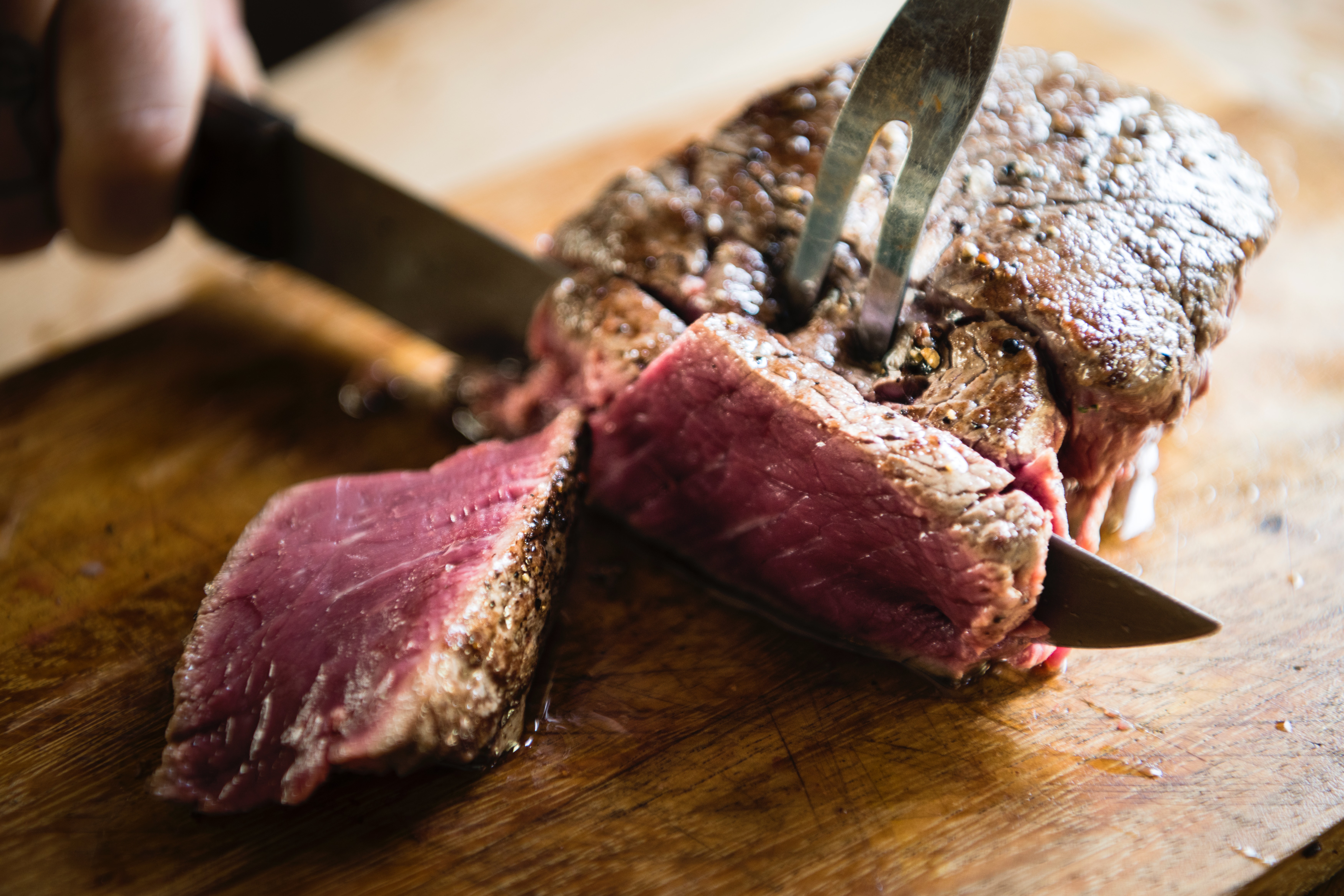
For things like roast beef, I recommend browning the surface of the meat either before or after sous-vide.
Seared meat has that wonderful savory smell, right? That's it!
It's called the Maillard reaction: amino acids and sugars in the cells come out and, when heated, produce aromatic compounds.
The Maillard reaction proceeds best at 155°C (311°F).
You might think you should use high heat, but that temperature is actually about medium-low heat.
Unless your pan retains heat well, like cast iron, you might go a little higher, but be careful not to overdo it.
Bacteria are said to be more on the surface of the meat, so browning the surface isn't just for flavor, it also helps with pasteurization!
So, to recap:
- Pasteurization requires cooking at 55°C or above
- Cooking at 55°C to 65°C keeps the meat's moisture and tastes great
- For sinewy or fatty meat, consider higher temperatures of 65°C or above
Now it's just a matter of practice.
Try sous-vide on different cuts and find the temperature you like!
I wrote about the Anova sous-vide cooker I bought in a separate article.
If you're thinking of buying one, have a read!