Tim Ho Wan Hibiya: Every Dim Sum on the Menu, Ranked
Translated from my original Japanese post (2020). 日本語の原文を読む →
Salut! It's Yoko.
For a celebration with my work friends, I went to Tim Ho Wan, the restaurant with the longest line in Hibiya!
Tim Ho Wan is famous as a dim sum restaurant that earned a Michelin star and yet is casual to eat at.
But basically you can't make a reservation! That's why the line is huge every day, lol
It may well be the most crowded restaurant in Hibiya right now...?
This time, we ate our way through the entire menu at Tim Ho Wan!!
If you're heading to Tim Ho Wan, use this as a reference for what to order!
Tim Ho Wan Recommended Menu Ranking!
First, the Tim Ho Wan menu. Counting desserts, there are 28 items in all.

After eating all 28, I'll announce my totally subjective, personal-taste ranking of the dim sum that tasted best, by category!
Boiled Dim Sum
The boiled dim sum category has two kinds of boiled greens, which work as a palate cleanser.
No. 2: Warm Lettuce, ¥480

It tastes just like it looks, lol. But I like warm, soft, wilted lettuce.
Recommended if you feel like you haven't been getting enough fiber lately.
No. 1: Warm Vegetables, ¥580

This unfamiliar vegetable is "gai lan," a relative of cabbage and broccoli,
also known as Chinese broccoli or stem broccoli.
It has great flavor and a pleasant bite, so I highly recommend it!
It tasted like broccoli, komatsuna, and asparagus added together and divided by three.
It's often used in Cantonese cooking, but it isn't widely distributed and you can't buy it at the supermarket, so it's pretty rare.
Steamed Dim Sum
Steamed dim sum is light, so it's best eaten early in the meal.
There are 10 kinds in all.
No. 10: Hong Kong-Style Braised Chicken Feet with Abalone Sauce, ¥580

This might not work for people who dislike offal-type foods (that's me). It's chicken feet, so there are bones that make it hard to eat, and there's not much meat.
The texture is jiggly and the seasoning is well absorbed, so it tastes good.
No. 9: Steamed Spare Ribs with Black Bean Sauce, ¥580

Douchi is a salty ingredient made from fermented beans, and it sometimes appears at Chinese restaurants that serve more elaborate dishes.
There are bones, so it's a little hard to eat, but delicious!
No. 8: Malai Gao (Steamed Sponge Cake), ¥480

At Tim Ho Wan it isn't treated as a dessert but is classed as steamed dim sum.
It's like a brown sugar steamed bun, and yummy.
In its homeland, apparently it's eaten between sweet and spicy dishes.
No. 7: Yuba Rolls Steamed with Oyster Sauce, ¥580

It has carrot on top and pork and shrimp inside.
I personally love yuba (tofu skin), so that alone makes me happy,
and then it's topped with oyster sauce, a powerhouse of umami... could it get any better?
No. 6: Steamed Shrimp Dumplings (Har Gow), ¥580

A simple steamed dumpling with the fun, springy texture of shrimp.
Light. Reliably good.
No. 5: Steamed Shrimp and Chive Dumplings, ¥580

The shrimp and chives show through the wrapper beautifully. It has that springy shrimp texture, and it's yummy.
No. 4: Pork Wontons in Spicy Black Vinegar, ¥580

Irresistible if you love cilantro! Pork wontons served in a sauce of aromatic vegetables and black vinegar.
No. 3: Beef Balls with Dried Tangerine Peel, ¥680

Chewy beef meatballs, with yuba laid underneath.
They contain chenpi (dried orange peel), which gives a lovely fresh aroma.
No. 2: Pork and Shrimp Shumai, ¥580

Pork and shrimp, two ingredients with strong umami, are combined for a springy bite
and juiciness, and it's delicious!
Neither flavor is lost; instead you get to enjoy the two heavyweights performing together in one shumai.
No. 1: Steamed Seven-Vegetable Dumplings, ¥480

A beautiful steamed dumpling with colorful ingredients showing through! It's all vegetables, so it's healthy.
It contains carrot, wood ear mushroom, bamboo shoots, mushrooms, straw mushrooms, celery, and green beans.
It's packed with aroma and umami, and really delicious.
I think painstaking dishes like this are exactly what you should order at a restaurant.
Imagine gathering that many vegetables at home and chopping them all... it makes my head spin, lol
A dish I really want you to try.
Rice Rolls
Rice rolls, also called cheong fun,
are steamed rice-flour sheets wrapped around fillings like shrimp or pork.
You sometimes see them in Yokohama's Chinatown or at authentic Chinese restaurants.
Tim Ho Wan has three kinds.
No. 3: Shrimp and Yellow Chive Cheong Fun, ¥680

Light and clean.
Recommended for people who want to try many kinds but still want to cover cheong fun!
No. 2: Minced Beef Cheong Fun, ¥680

A pairing that reminds me of gyoza.
Beef shows up in only this, the beef balls, and the steamed rice.
No. 1: Char Siu Cheong Fun, ¥680

Cute cheong fun with pale pink char siu showing through.
It has the boldest flavor among the cheong fun fillings, and balances nicely with the mild rice sheet.
Baked Dim Sum and Drinks

The drink to order is Tsingtao beer. It's a clean, crisp beer that goes well with dim sum.
However, I'm not much of a beer person.
I wanted a sour (a Japanese-style mixed drink) but they didn't have any, so I drank oolong tea the whole time.
That said, something like pu-erh tea is free with unlimited refills.
The only baked dim sum is the turnip cake (¥480), but I forgot to take a photo!!!!
It had a standard flavor.
Fried Dim Sum
Surprisingly, there are only three fried items.
No. 3: Fried Spring Rolls with Mushrooms and Bamboo Shoots, ¥580

They're fried spring rolls but light, since they contain mushrooms and bamboo shoots.
Tastes like a classic Chinese spring roll!
No. 2: Shrimp and Yuba Spring Rolls, ¥680

A big win for yuba and shrimp lovers. The toasty flavor of the yuba is great.
No. 1: Fried Eggplant with Shrimp Balls, ¥580

This is delicious!
The shrimp on top is springy and the eggplant is meltingly soft.
Steamed Rice and Congee
There are five kinds of rice dishes to finish.
No. 5: Steamed Rice with Spare Ribs, ¥680

I forced myself to order it because I wanted to try everything,
but since we'd already had the steamed spare ribs with black bean sauce,
it felt a bit like "What, again?" or maybe it didn't...
I think it's better to pick one or the other, lol
No. 4: Steamed Rice with Pork and Ginger, ¥580

It's topped with something that looks like ginseng. The ginger aroma is lovely, the pork smell is gone, and it's light and delicious!
No. 3: Steamed Rice with Minced Beef and Egg, ¥680

Hm? It looks a bit different from the menu photo below...

The egg was probably big, and the sauce seems to have been held back on top, lol
When I broke the egg, something like gyoza filling came out from inside!

After the baked char siu bun, I think this is the No. 2 junk-food-style deliciousness at Tim Ho Wan!?
Kids will definitely love it.
No. 2: Salted Pork Congee with Century Egg and Salted Egg, ¥480

Congee that warms you up in the cold season.
The distinctive flavor of the century egg is irresistible.
No. 1: Lotus Leaf Sticky Rice, ¥780

When it was brought to the table, the wonderful aroma made us cheer.
Peel back the lotus leaf and the portion is generous!
Inside are chunks of pork and shiitake mushrooms seasoned sweet and savory.
Everyone had been saying they were full, but it vanished in an instant, lol
Desserts
The desserts include some unusual ones, which is fun!
No. 3: Fried Milk, ¥480

W-wow, this is sweet! Fried food to finish, with a milk jelly inside. It tastes like Milky candy.

One bite was enough for me, but it's a fun dish you won't find anywhere else.
Recommended for people with a sweet tooth or who still have plenty of room in their stomachs.
No. 2: Coconut Milk of the Day with Tapioca, ¥480

A crowd-pleasing coconut milk. It was the lighter, thinner kind, so you can manage it even when stuffed.
It's the only dessert with fruit.
No. 1: Osmanthus and Goji Berry Jelly, ¥380

I love the sweet scent of osmanthus!! Goji berries themselves are a popular Chinese ingredient,
but thanks to the osmanthus it becomes a very refined dessert.
It's a jelly, so it's fine even when you're full, and it's highly recommended as a palate cleanser!
It was a flavor I'd never had before.
Baked
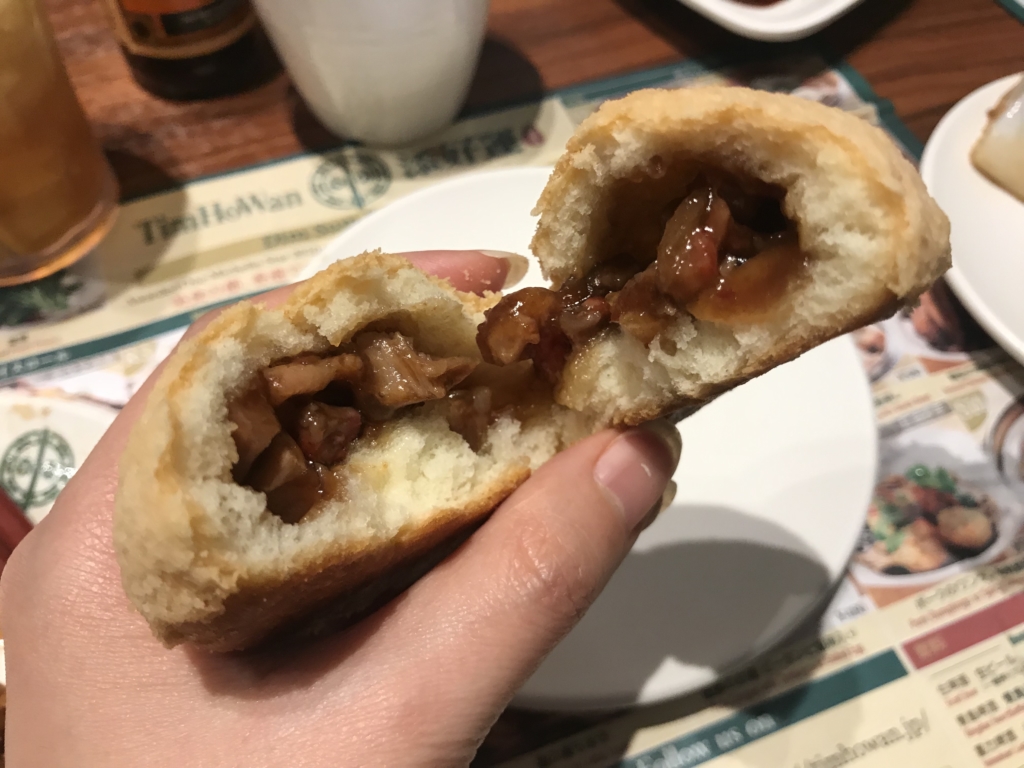
The last dish I'll introduce is this "Baked Char Siu Bun."
It tastes like a melon pan (a sweet Japanese bun with a cookie crust) filled with a sweet-style meat bun filling.

Here's what it looks like inside when you break it open.
As the signature item, it's delicious! If you can't decide, definitely get this.
Takeout is available from outside the restaurant, so it's also recommended as a souvenir for sightseeing!
Recommended Ways to Eat
Some of Tim Ho Wan's dim sum are seasoned, but when you order a lot, they can start to feel a bit repetitive.
On the table there's Lea & Perrins, a thin Worcestershire sauce, and doubanjiang (chili bean paste), so it's a good idea to switch up the flavor now and then.

Lea & Perrins doesn't interfere much with the flavor of the dim sum.

The doubanjiang is strong on garlic and adds richness. It's not as spicy as it looks, so it's easy to use.
Also, it's easy to get the wrong idea, but Tim Ho Wan is not an all-you-can-eat restaurant!
So if you eat everything you'll be extremely full, and the bill will be considerable, lol
I think you'd need at least eight people to finish everything.
Discussing what to eat while you wait is fun, too.
How to Get In Without Waiting in Line
For anyone who wants to try Tim Ho Wan, here are some recommended times.
For work I often walk past Tim Ho Wan, and seriously, it's way too crowded, lol
This is what it looks like around 21:30 on a weekday.

There are generally around 20 people in front of the shop at any time.
I'm not that bad at waiting, but I bet most people would look at that number and say no way.
There are two ways to get in without waiting!!
Aim for off-peak times
If you go right before or just after opening, there's almost no line, so you get in on the first round.
Late afternoon (around 14:00-15:00) is also quiet and a real sweet spot.
How quickly you get in depends on how many people are already inside, so it's best to go at a time that isn't a normal mealtime.
Reserve a private room
The Shinjuku Southern Terrace branch, Tim Ho Wan's second location in Japan, has private rooms!

* The photo shows the private room at the Hibiya branch. It is not normally available for use.
There are three private rooms in all (4 seats, 6 seats, and 8 seats), and if you remove the partitions between them you can use them as one room with 10 seats.
There's a separate room charge of ¥1,000 per seat (excluding tax), but if you want to enjoy lots of dim sum you should go with a big group anyway, and if you think of it as buying back your waiting time, it's a bargain.
Tim Ho Wan Hibiya
Tim Ho Wan's chef is the dim sum master Mak Kwai Pui.
He worked as a dim sum chef at Lung King Heen, the Cantonese restaurant at the Four Seasons Hotel Hong Kong, which earned three Michelin stars for four years in a row.
Together with chef Leung Fai Keung, he opened Tim Ho Wan in 2009.
It became the talk of the town for offering top-class flavors at casual prices, and it earned one Michelin star in 2010.
You can enjoy delicious dim sum, starting with the baked char siu bun, so please go try it!!
Hibiya Chanter Annex 1F, 1-2-2 Yurakucho, Chiyoda-ku, Tokyo 100-0006
03-6550-8818
11:00-22:00
Open daily (follows Chanter's business days)