Graneat Ginza: An All-You-Can-Eat Buffet of GAP-Certified Produce
Translated from my original Japanese post (2019). 日本語の原文を読む →
It's Yoko, the food blogger who eats her way around the world!
Recently a foodie friend invited me to a restaurant that opened on March 20, Graneat Ginza!
This place is amazing! What's so amazing? More than 90% of the ingredients used are GAP-certified!
They mainly use produce from farms certified under the international-standard GAP schemes JGAP, ASIAGAP and GLOBALGAP,
and they also use prefectural GAP schemes, which are accepted in the food procurement standards for the Tokyo Olympics and Paralympics.
GAP? What's that? Most people probably ask, so let me explain briefly.
What is GAP certification?

GAP stands for Good Agricultural Practice.
It refers to managing production processes in agriculture to ensure sustainability in food quality and safety, environmental protection, worker safety and more.
To get GAP certification, you have to be inspected by a certification body and pass more than 100 audit items!
I looked into what the audit items are like. Here are a few examples.
"Handle cattle with care, and when performing procedures such as dehorning, use methods that cause as little pain as possible."
"Keep records of the feed given to shipped products and of treatment and medication for each animal or herd."
"Hold a discussion between employer and workers at least once a year about working conditions, the work environment and work safety, and keep a record of it."
Hmm... animal welfare, traceability, labor management. It's quite a strict certification that checks a very wide range.
In Europe, GAP is simply an obligation
GAP began to be taken seriously in Germany and the UK around the 1970s, but in 2005 the policy became that products without EUREPGAP would not be sold at EUREP member retailers!
And the government would not give subsidies either! After that, it spread rapidly. EUREPGAP is the GAP scheme created by the Euro-Retailer Produce Working Group (EUREP).
The idea of GAP gradually spread to countries outside Europe, and in 2007 EUREPGAP was renamed GLOBALG.A.P. Today GLOBALG.A.P. is the world-standard GAP.
The differences between JGAP, GLOBALG.A.P. and FDA GAP
Each country has its own certification bodies for GAP, with different names and audit items.
GLOBALG.A.P., practiced in over 120 countries, is the world standard. The US has FDA GAP.
Japan has JGAP and also ASIAGAP, which Japan is trying to promote as the Asian standard.
Retailers sometimes create their own schemes as well, so I can't pin them all down precisely...
That said, they don't seem to differ very much.
For example, FDA GAP covers only food safety and not environmental protection, so there are some differences, but about 90% of the food safety rules are the same.
GAP is not well known in Japan...
Even though GAP is becoming standard practice around the world, it has barely spread in Japan.
As of March 2017, of the 1.26 million farms in Japan, only 4,113 were JGAP certified. That is a mere 0.3% of the total, not even 1%.
For example, right now a search for products advertised as JGAP on Rakuten Ichiba (a major Japanese online mall) returns only 92 results.
But I think awareness will grow little by little from here.
That's because for the 2020 Olympics and Paralympics, ingredients used in the Athletes' Village must be GAP certified!
In 2017, Daichi o Mamoru Kai and Oisix announced support measures including free guidance on obtaining GAP certification and covering the audit fees,
and AEON and Costco have announced policies to increase their GAP produce.
Apparently at Costco, 85% of the produce section is already becoming GAP-certified.
Maybe eventually everything will be GAP...
Graneat Ginza, Japan's first GAP-certified restaurant
I hope that gave you a bit of an idea about GAP certification, so enough of the introduction. On to the main topic, Graneat Ginza...
Graneat Ginza is on the second floor of Ginza INZ 2.

The concept is "GAP-certified ingredients" x "live buffet," so it's a buffet-style restaurant at both lunch and dinner.
Right inside the entrance, fresh vegetables are on display!

I was curious about a door and had it opened for me. It turned out to be a refrigerator, with leafy greens peeking out.

On the wall in front of the cashier counter, the GAP-certified farms are displayed in a long row.

While I was gazing at it, a staff member came over and said, "This is your first visit, isn't it? Let me explain," and told me about GAP certification.
What impressed me most were the farms with the GLOBALG.A.P. and organic marks.
Growing crops to meet so many standards must be a lot of hard work, and I respect that...
The gorgeous interior of Graneat Ginza
True to the "live buffet" theme, the restaurant is designed so you can enjoy the food while watching it being cooked.

It's mainly table seating, and there are private rooms at the back, so it looks very practical.

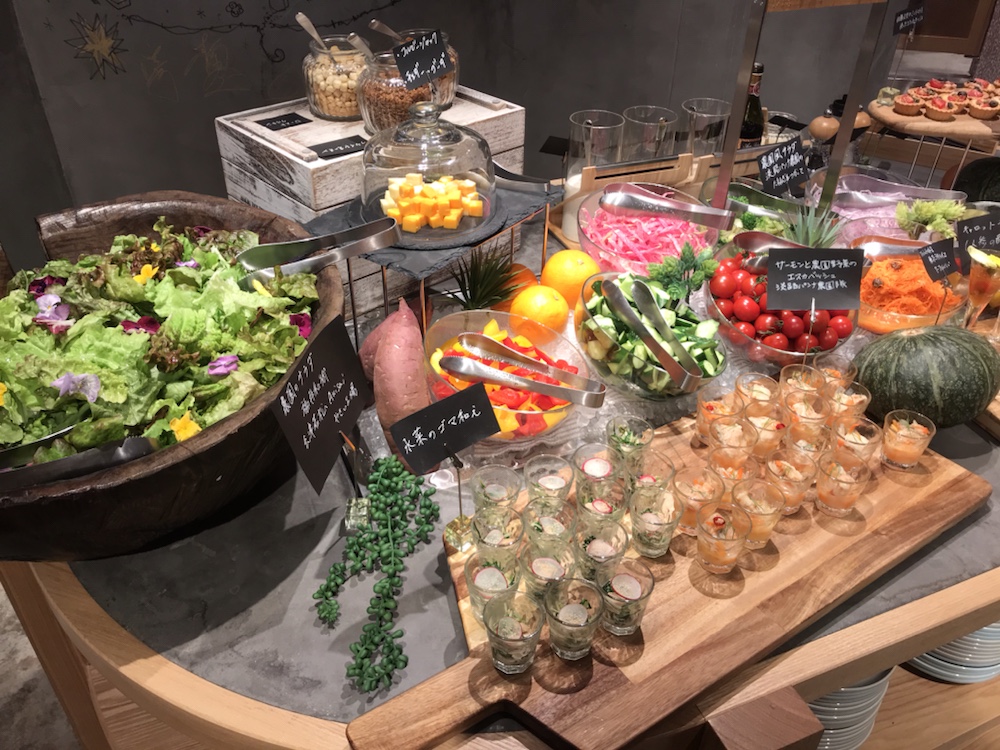
The first thing that catches your eye is the table of appetizers!

Colorful, obviously fresh vegetables are lined up, and just looking at them is exciting!
Each one comes with a note giving the farmer's name and what the dish is!

This is the fried food corner. They even advise which sauces go well with fried food, such as cassis mustard and tartar sauce made with shibazuke (red-shiso pickles).

The Staub pots hold grilled vegetables and stewed dishes.

In the corner is ice cream, in three flavors: apple, lemon and matcha.

For drinks, you can choose from black tea, green tea, water, detox water and orange juice.

I tried the orange juice and it was so good my eyes went wide.

There are desserts too! First, roll cake and matcha nama chocolate.

Roasted sweet potato cut into bite-sized pieces.

Pineapple and grapes. The grapes are seedless, the kind you can eat with the skin on!

15 minutes gone just taking photos... time to eat in a hurry
If you're going for the Instagram shots, watch the time (lol).
Everything was so beautiful that I kept shooting photos, and 15 minutes went by in no time.
I tried every type, so let me walk you through it starting with the appetizers!
The tomatoes are sweet and rich!
My top pick among the salads is the tomato. It's super sweet and delicious! I could easily eat 20.

There are classics like carottes rapees and potato salad, as well as twists like fried burdock root.
The potato salad's spoon looked like a little shovel, which was cute!

I was moved by how moist the chicken ham is
My top picks from the grill corner are the chicken ham and roast pork. They're cooked to a perfect, moist doneness!
You eat them with the shibazuke tartar sauce and the apple sauce, respectively.

I happened to chat with the owner, Yasuaki Takeda, who was at the restaurant,
and he said, "I want people to enjoy tempura freshly made,"
so they fry it after you order. You get it crispy and hot!

I enjoyed shungiku (garland chrysanthemum), eggplant and kabocha with three kinds of salt.

Even the ice cream is homemade!
Mr. Takeda kindly gave me a tomato sorbet that he's still developing!
He said, "After three days the flavor changes already."
I was moved to be eating such fresh ice cream...!

It had olive oil on top and a rich, creamy texture, kind of like gelato.
With my mouth refreshed, I headed to the grill and stew corner.

In the deep bowl are Chinese cabbage milk soup and a stew of pork and apple.
The sweet potato is creamy and its sweetness is drawn out to the limit...! It's practically dessert.

There was ajillo too. The fried chicken with a sweet cilantro sauce was delicious.

When I went for dessert at the end, I realized I hadn't had the takikomi gohan (seasoned rice), white rice or bread, and my plate turned chaotic...

I ate all three ice creams too, of course (lol).

Phew, I'm full. The toothpicks looked like a flower garden and were cute too!

Graneat Ginza prices

Graneat Ginza (Tabelog)
Now, the question of price...
First, it's all-you-can-eat plus unlimited soft drinks for 90 minutes at lunch and 120 minutes at dinner!
You can add unlimited wine from ¥1,000 (lol).

Here are the prices.
Lunch: weekdays ¥2,500 (excl. tax), weekends and holidays ¥2,800 (excl. tax). Ages 6 to 12: ¥1,300 (excl. tax)
Dinner: weekdays ¥3,500 (excl. tax), weekends and holidays ¥3,800 (excl. tax). Ages 6 to 12: ¥1,800 (excl. tax)
I liked that you can use a credit card even at lunch.
Children aged 5 and under are free, so it might be good for a moms' get-together with kids.
Parents with children especially might care about where the ingredients come from and how they're managed.
I sometimes feel uneasy about that when I eat out too, so I was glad to eat with peace of mind this time.
Everything is cooked to let the natural flavor of the ingredients shine, and the beautiful presentation is a treat too, so I suspect it will soon get hard to book...
If you haven't been to Graneat Ginza yet, do go experience GAP-certified ingredients while you can!

Graneat Ginza
Ginza INZ 2, 2F, Ginza 2-chome 2-banchi-saki, Chuo-ku, Tokyo 104-0061
11:00-15:30 (last entry 14:30), 17:00-22:00 (last entry 20:30)
03-6228-7283. Online reservations available.