Afternoon Tea at Akasaka Palace, Tokyo's State Guest House
Translated from my original Japanese post (2019). 日本語の原文を読む →
Salut! It's Yoko, the food blogger who's a little too into France.
The rainy season has started in Tokyo, so every day is muggy...
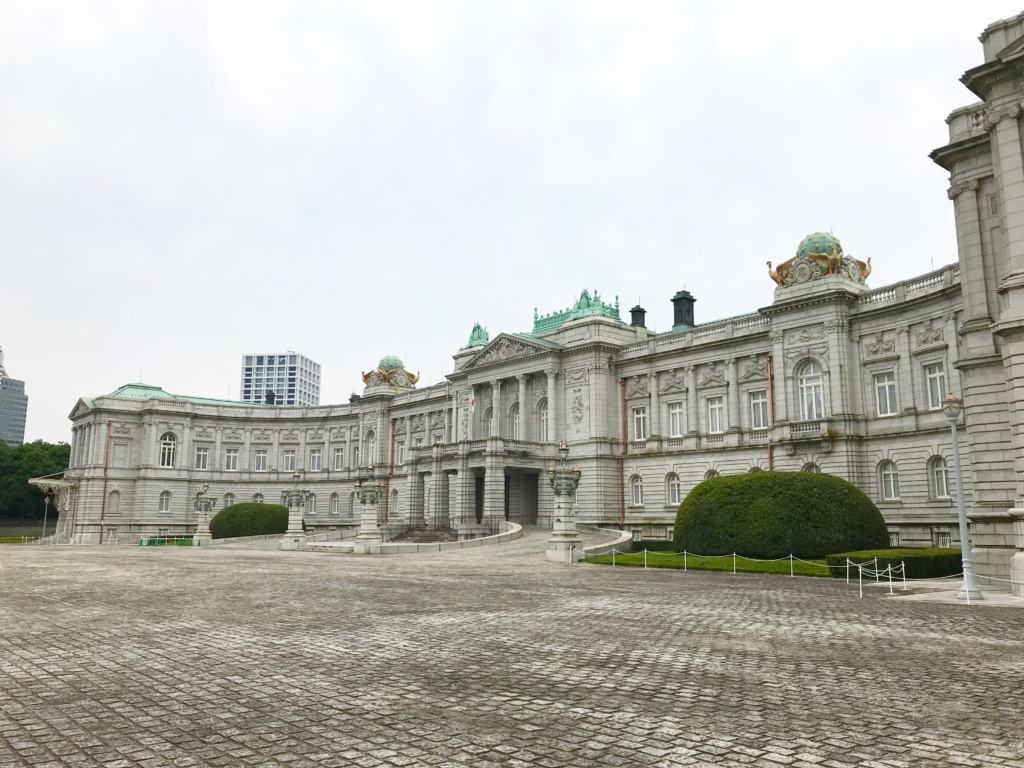
Today I'm sharing a place that's perfect if you want to blow away the damp gloom, or if you love France so much you'd like to live in a castle: a spot where you can feel like you live in a palace without leaving Tokyo, Akasaka Palace (the State Guest House).
What kind of place is Akasaka Palace?
Roughly speaking, it's a facility for hosting presidents and other leaders from overseas!
It was originally built in 1909 (Meiji 42) as a residence for the Taisho Emperor, and it's the only neo-Baroque palace building in Japan.
It brought together the best of Japanese architecture and craftsmanship of the time, and is based on Western architecture with decoration that's uniquely Japanese.
After World War II, as Japan became more international and welcomed more foreign dignitaries, it underwent a major renovation in 1974.
A Japanese-style annex was added, and it was reborn as the Akasaka State Guest House for diplomacy, which is how it stands today.
Normally it hosts state banquets and press conferences,
but amazingly, part of Akasaka Palace is open to the public, and unless you're in a group, you can drop in without a reservation!
There's even a service where you can enjoy afternoon tea in the palace's front garden,
making it a hidden gem for a luxurious time.
Off to Akasaka Palace!
I recommend walking from Yotsuya Station or taking a taxi.
We went in through the West Gate, which looks a bit like a back entrance at first glance.
There's no dress code, so everyday clothes are fine,
but you'll be strolling on gravel paths, so comfortable walking shoes are best.

Wait, is there going to be a line this long? For a second I was startled by a Disneyland-style queuing area.

As you can see, it was empty and we didn't have to wait at all, but there's a strict bag check and metal detector.
It feels like boarding a plane.
When you think about it, it's a government facility, so of course.
I picked up a map and other leaflets from the table.

Now, let's buy tickets.

The garden only was ¥300, and ¥1,500 if you also tour the inside of the palace.
Note that the Japanese-style annex requires an advance application and is chosen by lottery (I didn't know, so we couldn't go in... sob).
You can apply on the official Akasaka Palace website.
Tickets are sold at a machine, but cash only, so be careful.

Got our tickets without a hitch.

While using the restroom in building 15, I snapped a photo of the rest area. It has WiFi and a corner where you can watch videos about the palace.

And now, into the palace itself...
I'd love to show you what the inside looks like, but...
photography is prohibited inside Akasaka Palace, so I'll show a few pages from the pamphlet instead.
Spoiler photos follow, so if you'd rather save the surprise for your visit, scroll quickly
down to "Spoilers end here."
This is the pamphlet we received inside the palace. It was quite sturdily made.

Parts of the corridors have mosaic-style geometric patterns in marble.
The right side is apparently the tableware cabinet of the banquet hall... but where do the dishes even go, lol? It's so ornate I couldn't tell, lol.

The entrance hall, where foreign guests are first received.
The white parts are Italian marble, and the black parts are genseki stone from Miyagi Prefecture.

This is the "Sairan no Ma" (Sairan Room), used for summit meetings.
It's known for its fireplace of French marble and a pleated ceiling reminiscent of a field tent.

This is the "Hagoromo no Ma" (Hagoromo Room). It has the three largest chandeliers in Akasaka Palace, plus an orchestra pit.
It's used for concerts and as a place to serve aperitifs to banquet guests.

Spoilers end here
The inside isn't that big, so you can see everything in less than an hour.
Guides stand every few dozen meters throughout the palace, showing visitors around and answering questions.
The interior blends Western and Japanese motifs beautifully, and, as you'd expect from clean-loving Japan, it's kept spotless.
Here's the palace as seen from the side after we stepped outside from its splendid interior.

And here's the back of the palace, facing the main garden with its fountain.

The fountain is huge! There were a few benches, too.
We were ready for tea by then, so we headed to the front garden.
Walking back the way we came, there it was...
A truly majestic building!
It's Western in style overall, but you can see Japanese motifs such as mythical birds as decoration.
In the front garden there are photographers for hire, a souvenir shop, and a mobile cafe.


The afternoon tea I was after was sadly sold out, so I had tea and a scone instead.

Mmm, what a view!

There were lots of tourists, so people got into the background, but this is how you can relax slowly while gazing at the palace!

I think it's the perfect place when you're tired of ordinary cafes.
We ended up staying quite a while.
On the way out, you first pass through the Middle Gate.
The view from the Middle Gate is the prettiest!!

Once you pass through the very tall main gate, it's time to say goodbye to the palace. I didn't want to leave!


Yotsuya Station is just a few minutes' walk from the gate.
Akasaka Palace offers an unusual, out-of-the-ordinary and luxurious tea time,
so if you're interested in architecture or like having tea on a terrace, keep it in mind as a place to relax after a tiring week.
Bonus tip: if you want the afternoon tea, which is limited to 20 servings a day, aim for opening time (10:00). Assume it will be sold out on holiday afternoons.
*Last admission for the main building and garden is 16:00, so be careful.
See you next time! Au revoir!