Silky Homemade Chashu, Cooked Sous-Vide
Translated from my original Japanese post (2018). 日本語の原文を読む →
Hi! It's Yoko, and I've gotten really into low-temperature cooking lately.
Have you ever tried it? I'm guessing a lot of you have at least heard of it.
Meat comes out wonderfully moist, and vegetables get sweeter, so I really recommend it.
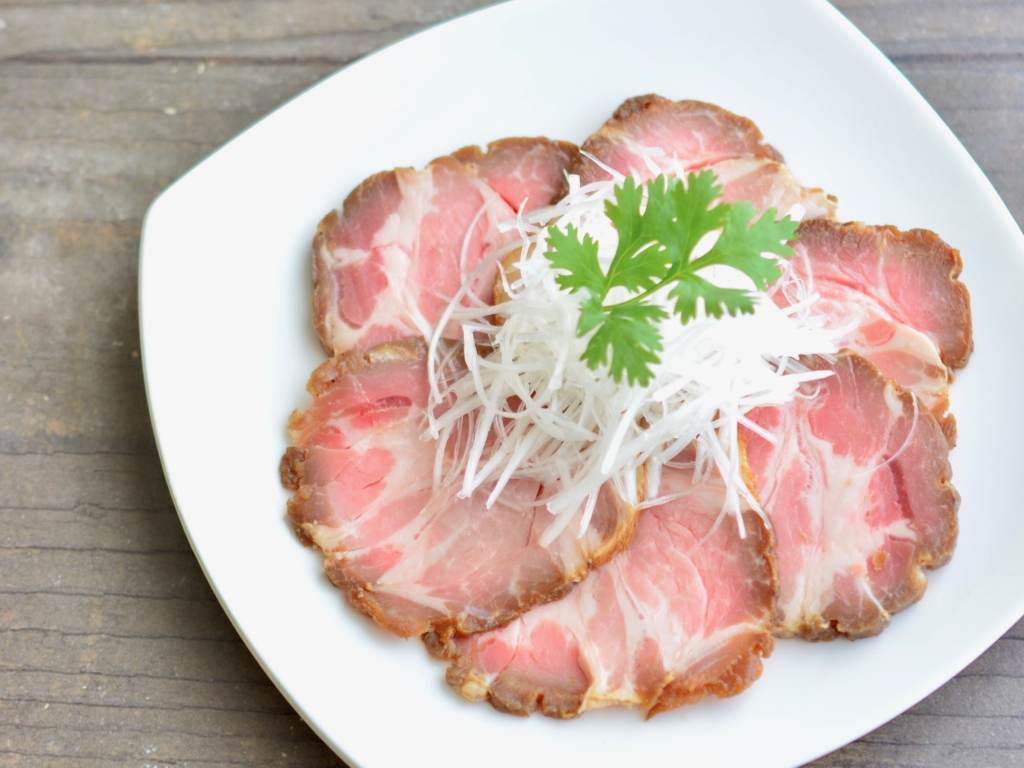
Today I'm sharing a homemade chashu (braised pork) I made this way!
Cooking it slowly at a low temperature gives you super silky, pink chashu.
Silky Homemade Chashu
Ingredients
Soy sauce: 5 tbsp
Miso: 1 tbsp
Oyster sauce: 1 tbsp
Shaoxing wine: 1 tbsp
Five-spice powder: 1 tsp
Sugar: 3 tbsp
Honey: 3 tbsp
Garlic and ginger: 1 piece (clove or knob) each
Directions
1. Poke holes all over the pork with a fork. If the thickness is uneven, tie it with kitchen twine into an even cylinder. Smash the garlic with the back of a knife. Slice the ginger thinly.
2. Put all the ingredients in a plastic bag, massage well, and leave it overnight.
3. Take the garlic and ginger out of the bag. Pour the marinade into a frying pan and simmer over low heat until it thickens.
4. Bring the pork back to room temperature, wrap it in aluminum foil, and bake in an oven preheated to 100°C for 2 hours.
5. Take the pork out and unwrap the foil. Preheat the oven to 200°C. While you wait, spoon the reduced sauce over the pork.
6. Put the pork in the oven for 5 minutes. After 5 minutes, flip it, spoon more sauce over it, and bake for another 5 minutes.
7. When it's done, wrap it in foil and let it rest. Once it has cooled slightly, it's ready.
Note: If you eat the chashu on its own, topping it with shirogane negi (finely shredded leek) or cilantro makes it look lovely!
Tips
Five-spice powder, the all-purpose seasoning
Five-spice powder (wu xiang fen) is a blend of five spices, including star anise, cinnamon and cloves, and one pinch gives you an authentic Chinese flavor.
Even a small amount has a strong aroma, so go easy if you're not a fan. I use it whenever I make Chinese or Taiwanese food.
Don't forget to kill bacteria when cooking at low temperatures!
With low-temperature cooking, you need to heat slowly and, once you reach the target temperature, hold it there for a while.
That's because high heat cooks the meat through but makes it tough, while a short time at low heat doesn't kill bacteria.
In Japan, for food safety, meat needs to be heated to at least 63°C for 30 minutes or more, or treated in a way that has an equivalent effect.
From experience, setting the target to 63°C cooks the pork a little more than I like, so instead I lower the temperature and set a longer cooking time.
I use the oven because temperature control in a pot is hard, and the keep-warm setting on a rice cooker runs at 70°C or higher.
(I'm planning to buy an ANOVA (sous-vide cooker) soon, which should solve this problem. But it's a pretty niche gadget, so I wrote this as an oven recipe.)
Everyone likes their meat cooked a different amount, and oven temperatures vary by model, so try it a few times and find the temperature and time that feel just right to you.
Once the chashu is done, cut it into cubes or thin slices and freeze it. It's handy for fried rice or ramen whenever you need it.