My First Gastroscopy: Does It Hurt?
Translated from my original Japanese post (2018). 日本語の原文を読む →
Hi, it's Yoko.
I recently had my first gastroscopy (an endoscopic exam of the stomach)!
Before the exam I was so anxious I couldn't help it and googled what it involves over and over, but once it was over it was no big deal. Yay!
So if you're about to have your first one and feel really nervous like I did, I hope this article helps you feel a bit more at ease!
A positive H. pylori result at my health checkup
What led me to the gastroscopy was the comprehensive health checkup (ningen dock) I had this summer.
(A gastroscopy is a gastric endoscopy. I'll just call it a gastroscopy below.)
(Source: Esophageal endoscopy | National Cancer Center Japan...)
The reason was that my results came back positive for H. pylori (Helicobacter pylori).
In fact, my blood test had been positive for H. pylori around spring this year too, but I didn't know much then and just thought, "I'll check it next time I'm at a hospital anyway."
By the time of the checkup, I'd completely forgotten about it...
About a month later, the results arrived. The envelope is usually flat, but this one was quite thick...
When I opened it there were two referral letters, one of them to a gynecologist, telling me to get a colposcopy.
The other one seemed to have something like a DVD in it... (You can't open referral letters, so I'm guessing from how it felt.)
The checkup results said "gastritis" and told me to get a gastric endoscopy (scary).
H. pylori.
It has a cute-sounding name, but it's a frightening bacterium that causes stomach ulcers and stomach cancer.
The formal name is Helicobacter pylori.

(Source: Hyogo Medical University, Department of Internal Medicine, Gastroenterology)
And this little guy is in my stomach...

When I told my husband I'd tested positive, he said casually, "Isn't that the one that gives you stomach cancer? Horiemon wrote a book about it," which surprised me, so I googled it.
I found a site made by Horiemon (Takafumi Horie) and doctors to promote H. pylori eradication.
It explained H. pylori and stomach cancer carefully, and I read through it all.
(Source: "Is it really okay to get rid of H. pylori?" We asked doctors on the front lines)
A 3% chance that I could get stomach cancer made me panic...
Stomach cancer is an infection. H. pylori is the cause in 99%
Smoking, drinking, stress and many other factors have been said to cause stomach cancer, but according to that site, stomach cancer is actually an infectious disease!
H. pylori is behind 99% of cases.
Eradicating H. pylori lowers the chance of developing stomach cancer.
Whether H. pylori is really a bad bacterium is still debated, though, and some doctors don't recommend eradication.
But at the very least it lowers the chance of getting stomach cancer.
I decided to have it eradicated.
If a gastroscopy confirms an H. pylori infection, eradication therapy is covered by insurance in Japan.
But since it was my first time and I was scared, I started by looking for patient accounts and hospitals to learn what a gastroscopy is like.
What kind of exam is a gastroscopy?
There are two main types of gastroscope.
One goes in through the nose and the other through the mouth.
The nasal type is 3.8-5.8 mm in diameter and the oral type about 9-10 mm, and they hold a camera, a light and a scissors-like tool (for treatments like removing polyps).
With the oral type, the base of the tongue is pressed a little, so some people gag.
In exchange, the diameter is slightly larger, so the image is clearer.
With the nasal type, it doesn't touch the tongue, so gagging is less likely. But if your nostrils are too narrow or have a complicated shape, the camera can't get in and it has to go through the mouth.
A friend who had the nasal type has a delicate nose and said, "I had a huge nosebleed..."
After booking at the hospital, I spent my time torn between putting up with a possible nosebleed and lower image quality for an easier insertion, or a possible gag reflex with better image quality.
What happened on the day of the exam
First the doctor explained the procedure and said, "You can choose a nasal scope or an oral scope, whichever you like."
"If you're nervous, we can also give you a sedative (injection)."
After a few dozen seconds of "hmm...", I chose the oral scope with a sedative!
They measured my blood pressure and oxygen level, then sprayed an anesthetic on my throat. It tingled slightly, and after a while I lost feeling in the back of my throat.
I moved to the exam room and finally came face to face with the gastroscope!
It was about as thick as a pinky finger, so it looked more manageable than I expected.
First I was given the sedative while lying on my back. In a few dozen seconds, I felt relaxed and floaty, like I was very drunk. I was still conscious.
I lay on my side, a mouthpiece with a hole was put in, and the camera came into my mouth...
Maybe because I was nicely relaxed, I didn't gag, and the camera slid down smoothly... Huh, maybe it's easier than I thought?
The camera can apparently also blow in air, and when the doctor said, "You'll feel a bit bloated now," my stomach really did swell up and it felt weird (lol).
It was over easily in about 5 to 7 minutes.
Does a gastroscopy hurt?
Honestly, it didn't hurt at all! Of course, the sedative probably helped...
With the mouthpiece in, people normally drool constantly, but I was relaxed enough to swallow once without trouble (lol).
It was so much easier than I'd expected that I felt let down... Some hospitals do the procedure while you sleep, but that seems like a bit much to me.
Of course, everyone feels differently, but I'm wondering whether I'd use a sedative next time.
And the all-important result... as expected, it was atrophic gastritis caused by H. pylori, and I was prescribed medicine to eradicate it.
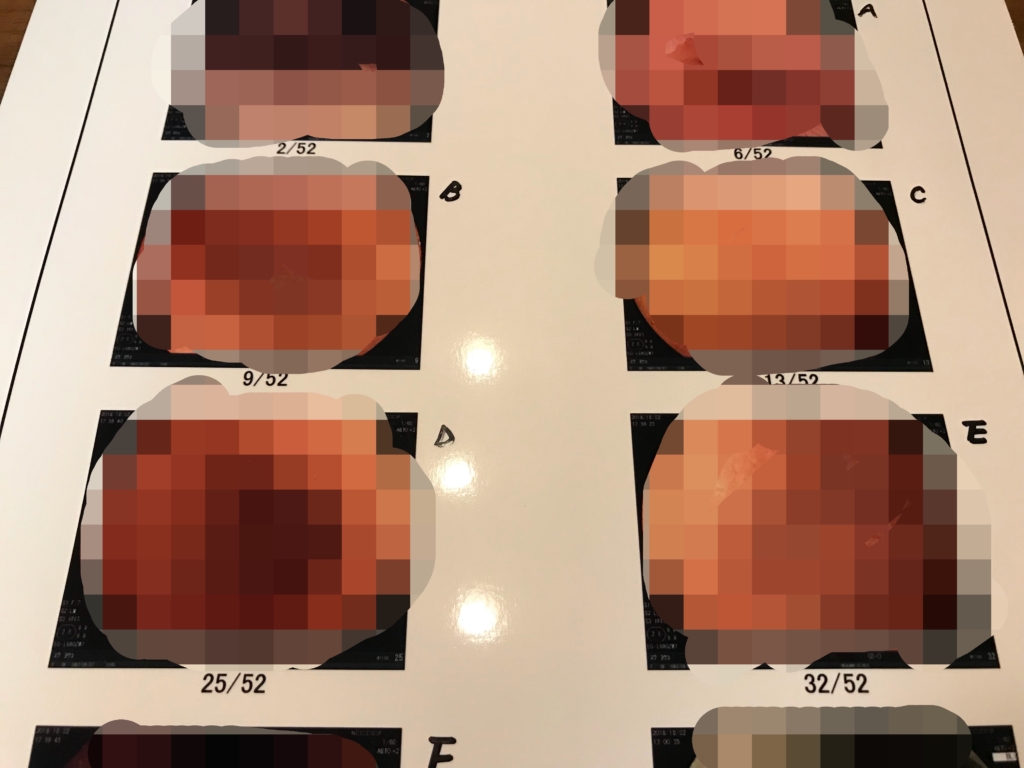
They also gave me a photo of the inside of my stomach, which I wanted as a souvenir.
It's a bit graphic, so I blurred it...
A stomach infected with H. pylori apparently has thick folds and a lot of mucus, but as a beginner seeing a stomach for the first time, I couldn't tell.
Still, I'm really glad it's nothing serious for now.
From now on I'll take medicine twice a day to defeat the H. pylori!
I want to get regular gastroscopies from now on
I'm relieved that the gastroscopy was less of a big deal than I expected, but what's mysterious is that until 2017 I had blood tests at my health checkup every year and was negative, yet this time I suddenly tested positive...
I sometimes feel down or lose my appetite, but otherwise I'm perfectly healthy.
Was the tap water in France bad?
Did the H. pylori that was already there grow stronger?
Or maybe it wasn't a test item until last year...?
Hmm, I have no idea what the cause was.
But now I'm no longer afraid of the gastroscopy, and I've also had the barium test, so I plan to get a gastroscopy every year, which is more accurate at finding disease!
I hope the H. pylori is gone by this time next year!
If you're reading this and you're H. pylori positive, go to a gastroenterology clinic soon!
If you stay relaxed, it's nothing!