Kabi, Meguro: A World of Fermentation
Translated from my original Japanese post (2019). 日本語の原文を読む →
Salut! It's Yoko, the food blogger.
I went to "Kabi," a restaurant my foodie friends have been talking about lately!
Kabi's theme is fermented food

Kabi's chef, Shohei Yasuda, used to work at Kadeau, a one-Michelin-star restaurant in Copenhagen, Denmark.
Kadeau's food isn't traditional Nordic fare like salmon, herring and mashed potatoes. It's an avant-garde style known as New Nordic cuisine.
Kadeau uses local ingredients and is known for its sense of the seasons and artful, beautiful plating.
In Denmark, food preservation techniques developed to get through the long, harsh winters, and pickles are used often.
Seeing a link with Japanese fermented foods like miso, he apparently even put nukazuke (rice-bran pickles) on the menu.
Kabi's sommelier, Kentaro Emoto, studied viticulture and enology at the University of California, Davis,
and worked as head sommelier at NORA in Melbourne, Australia.
At the end of 2016 the two, both back in Japan, met at a wine bar and hit it off. They started holding events fairly often.
Worrying about where to store their ingredients is what led them to open Kabi.
When I hear Nordic cuisine, I personally think first of noma (the world-famous restaurant in Denmark, like Kadeau), where ants and grasshoppers are used.
Fermented foods that Japanese people know well are much easier to approach than eating insects we don't normally eat, and Mr. Yasuda has apparently tried things like green pea miso and firefly squid miso. It's a fresh surprise to see how even familiar ingredients feel so appealing with just a slight change of approach.
Kabi's interior feels like a friend's event
It's on Meguro-dori, a fair walk from the station and hardly convenient, yet the restaurant was almost full!
The almost entirely glass-walled space is a renovated Japanese house, with gray mortar walls and floors that give it a warehouse feel.
There are candles on the tables.

Wait, is this a club? The lights are dimmed almost to the limit, and hip-hop style music plays at high volume.
The casual atmosphere feels like you've been invited to a friend's event.
The staff are stylish too, with dreadlocks and tattoos, and they serve you in a friendly way, as if a restaurant from overseas had been brought to Japan.
We sat at a table next to the counter, and there were quite a few people who looked like international visitors.

For first-time visitors to Japan, the standard is probably to eat in a classic Japanese setting with tempura or sukiyaki,
but I imagine repeat visitors would enjoy modern takes on Japanese food like this too.
Kabi's summer dinner course, "Summer Kabi"
The course we had this time is the summer-only course at ¥7,000.

I ordered the alcohol pairing too.
The menu had no Japanese, lol.
They explain everything in Japanese, so it's no problem at all, and I'm sure international visitors will love it.
- Okra and abalone salad, fermented tomato juice
- Aged sashimi
- Sardine tempura, paprika sauce
- Scallop and peach, sweet and spicy
- Kuruma prawn and green pepper, butter sauce
- Spare ribs, sansho and kombucha sauce
- Somen noodles in fermented shiitake juice
- Shirokuma shaved ice
Alcohol pairing ¥5,000
Non-alcohol pairing ¥4,000
The first pour was a Loire rose.
It's made from grapes such as Pinot Noir, Cabernet Franc and Grolleau.
It has gentle fruit, is sweet, and lightly sparkling.

Okra and abalone salad, fermented tomato juice

This was the one where the gap between looks and taste surprised me most!
It has okawakame (Okinawan spinach), abalone, okra, dashi, water shield (junsai) and fermented tomato juice.
It's translated as a salad, but the dish feels more like ohitashi (vegetables in dashi).
The thin film of oil floating on the dashi was incredibly rich and so delicious.
Sesame oil? What was it? I wish I'd asked...
Aged sashimi

Sea bass sashimi aged for two weeks, with okahijiki (land seaweed).
Aged fish is trendy lately. Unless it's properly drained of blood and rested it turns fishy, so I think you can pretty much only eat it in Japan.
The flesh is soft and delicious.
Sake from Gunma.

Sweet, with a crisp, clean finish.
Scallop and peach, sweet and spicy

Scallop, peach and fig, with pickled green chili and dried tofu.
It felt like a light palate cleanser.
Sardine tempura, paprika sauce

Sardine tempura. It comes with a paprika mayonnaise sauce and umeboshi (pickled plum) powder made by the chef's grandmother.
Even with ordinary ingredients, doesn't hearing "something from the chef's hometown" make it sound instantly more delicious? Or is that just me?
A Chardonnay from France's Jura region.

This one is clean and sweet too.
Kuruma prawn and green pepper, butter sauce

This was so delicious, exactly my kind of dish! At first glance all you see is zucchini, but...
Lift the zucchini and eggplant, green beans and kuruma prawn appear!

It's seasoned with fermented zucchini juice, and juice of green pepper and bitter melon, with sake lees from Nara-zuke pickles in a butter sauce.
The kuruma prawn miso (the head's innards) and the butter sauce go together far too well.
Gros Lolo.

A sweet natural wine. It doesn't have the funk typical of natural wine and has nice fruit.
Spare ribs, sansho and kombucha sauce

Spare ribs made with jasmine tea kombucha (not kombu-cha), with pickled parsnip and jalapeno.
The crisply grilled spare ribs are full of umami! I gnawed right down to the bone, leaving nothing behind.
Because the meat would get stuck in your teeth, they brought out toothpicks that I'm sure international guests would love.

Stylish down to the details...
Somen noodles in fermented shiitake juice
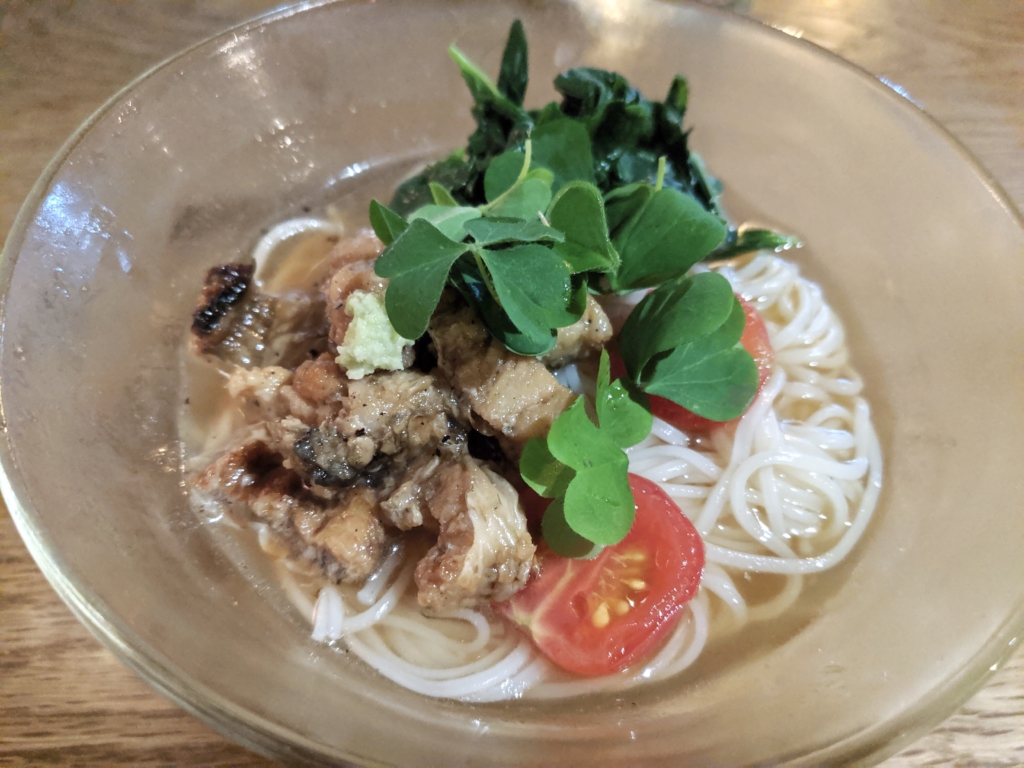
The somen is made in front of the chef's family home. The toppings are molokhia and conger eel.
The broth is fermented shiitake and mushroom juice with fermented tomato juice as the dashi.
The topping is clover! I didn't know you could eat it...!
The after-dinner drink was hojicha-flavored rum.

It has unpasteurized honey in it. Hojicha and rum go together 1,200% perfectly, so good.
Shirokuma shaved ice

It's topped with fruit such as warabimochi (bracken starch mochi) and banana.
The course ended with a typically Japanese summer dessert.
The portions are a little small, but there was plenty of variety and I got to eat meat too, so I was very satisfied.
The wines were mostly fruity and gentle, and I think they went well with the fermented food.
Even people who don't like wine could probably enjoy them.
Sneaking up to the bar on Kabi's second floor
You can head home after dinner, but you can also have a nightcap at the bar on Kabi's second floor.
A staff member led us up an old staircase, and...

A floor appeared that seemed to keep the charm of the Japanese house just as it was.

There are shoji screens and sake barrels used as tables.
The club feel is the same as downstairs, but with a lot more Japanese flavor.
By the way, off-duty staff are drinking up there too (if you call out to them, they will serve you properly).
The music playing upstairs was Haruomi Hosono's "Philharmony" ↓
It sounds somehow futuristic, but apparently it's an album from 1982...
The bar menu is original, with no slacking.

There were intriguing cocktails like a sansho gin and tonic and a watermelon and bonito, but I went with a lemon sour.

It has domestic lemon with butterbur shoot (fukinoto) syrup.
The gentle bitterness of the fukinoto lingers softly in the aftertaste. Delicious.

I was pretty tipsy, so I wobbled a little down the stairs and walked home through rainy Meguro.

So Kabi gave me a taste of a new side of Japanese fermented food, and I was very happy with the dinner!
There's an English menu, and some staff explain things in English or French, so it's perfect for taking adventurous friends from overseas.
Japanese diners can eat something different from familiar fermented foods like miso and shio koji, so do give it a try.
Until next time! Au revoir!
Getting to Kabi
It's on Meguro-dori, so the closest way is to drive, or take the bus from Meguro Station and get off at the third stop, Moto-Keibajo-mae.
Kabi
4-10-8 Meguro, Meguro-ku, Tokyo 153-0063
Closed Mondays
Tue, Thu, Fri 19:00-24:00
Wed, Sat 12:00-15:00, 19:00-24:00
Sun 12:00-15:00
03-6451-2413