Happy New Year! Homemade Osechi, 2019
Translated from my original Japanese post (2019). 日本語の原文を読む →
Happy New Year!
It's 2019.
"This year went by so fast!" is a pretty common thing to say,
but since I went abroad to study in 2018, it honestly felt more like three years to me.
I want to live as long as I can, so I sometimes look into ways to make time feel slower,
and apparently when people take on something new, the brain takes longer to process it.
When you spend a day just like every other, your brain is used to processing it, so it feels like an instant,
but when everything is a first, it feels like you've spent a long time.
I think 2018 felt slow because I experienced so many new things.
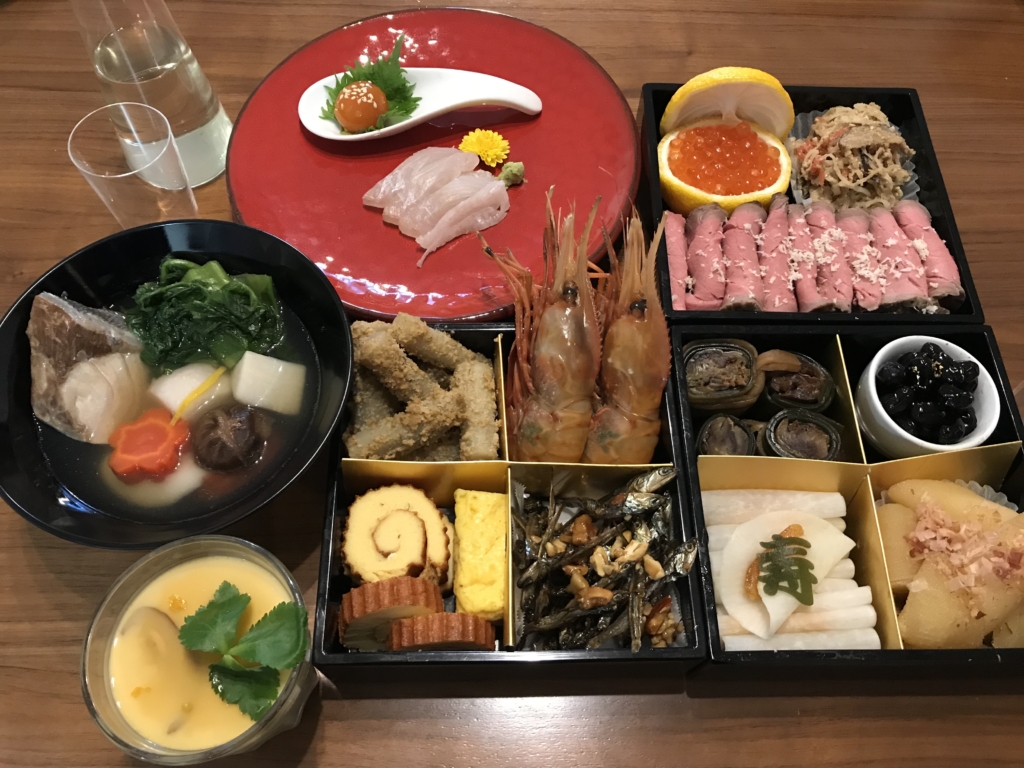
Anyway, I made osechi (the traditional New Year's feast) by hand again this year!
Every year I wonder whether to buy it or not, but I've made it myself for the past four years.
I'll leave a simple record of the recipes for next year's me and for anyone thinking about making osechi themselves.
Osechi basics
Before I show you my osechi, let's quickly review the basics.
The tiers of the box are called ichi-no-ju (first tier), ni-no-ju (second tier) and san-no-ju (third tier), from the top.
Traditionally, the first tier holds the celebratory appetizers (black beans, herring roe, candied small sardines) and kuchitori (sweet things such as kinton and datemaki).
The second tier holds vinegared dishes and grilled dishes.
And the third tier is for nishime (simmered vegetables).
The first year I made osechi I followed this, but this year I didn't worry about it and went with a MIX style, putting in whatever I wanted to eat.
First tier

I use a Muji jubako (tiered box).
It's a size that can feed about 2 to 4 people.
There's herring kelp roll instead of candied sardines, but there are two celebratory appetizers in here, so let's call this the first tier!
Three takeaways from the first tier.
For the herring kelp rolls, to make the herring soften faster, soft herring seems better than dried mikaki herring.
This time I used dried herring, so I had to be quite careful to get it tender.
Next, karasumi daikon (bottarga wrapped in daikon).
I just wrapped some bottarga that had been sitting in my freezer with daikon, so there's no real recipe, but it makes a great snack with sake.
It looks plain, so I decorated it with kelp! Kelp comes in other shapes and letters too, so it's an easy way to make things cute, and I highly recommend it.

And then the black beans. I usually use Tamba black beans (new crop), but this year I accidentally bought old-crop beans from Hokkaido. After soaking them well and simmering, they were plenty tasty.
The only difference from Tamba black beans is that the beans are a bit smaller!
They turned nicely black when I used an iron ball, too.
As something new, adding rum for a grown-up flavor was good too.
I finished them with gold leaf flakes for extra glamour!
Second tier

Now, the second tier.
This is normally the tier for grilled dishes, but...
the only grilled dish I have is roast beef! But let's call this the second tier anyway.
The salmon roe in the yuzu cups was a returned-gift item from the furusato nozei (hometown tax) program that had been sleeping in my freezer.
The namasu (vinegared daikon and carrot) is a plain color, but I like the sesame flavor, so I always add white ground sesame.
The carrots are Kyo-ninjin (Kyoto carrots), which have a stronger flavor than regular ones.
And this year's newcomer: roast beef.
It really does add glamour to the box.
I cooked it with an ANOVA (sous vide cooker) at 54.5 degrees (130.1°F) for about 5.5 to 6 hours.
The topping on the roast beef is horseradish (yama-wasabi).
It came out pink, but next time I'd like to change the cooking time and try it a little rarer!
However, if it's too rare it's hard to slice...
Restaurants have a special slicer. But this is home. Slicers are expensive.
Maybe I should freeze it slightly before cutting?
If you love sous vide and know how to slice thinly, please let me know.
Third tier

The third tier is traditionally for nishime, but I'm not a big fan, so I left it out completely.
The celebratory tazukuri (candied small dried sardines) has wandered over from the first tier.
Many people aren't keen on tazukuri, but I recommend this one.
First, I toss in unsalted mixed nuts to make it more of a "snack."
Also, I snap off the belly part of each sardine, which holds the bitter innards.
They're tiny, and it's tedious work, so I did it little by little while watching TV.
Then roasting them over low heat makes them crisp with a nice texture.
The tamagoyaki (rolled omelet) is made with shoro-style eggs, and it was delicious.
The datemaki (sweet rolled omelet) was baked in the oven with less sugar.
And the eye-catching botan shrimp are marinated in Shaoxing wine.
Chilling botan shrimp makes them sweeter, so they get even better while marinating!
Next time I'd like to try it with amaebi (sweet shrimp).
Ozoni

Since relatives on my father's side live in Fukuoka, I've had Hakata-style ozoni (New Year's rice cake soup) since I was a child.
Hakata ozoni is characterized by katsuo-na, ago dashi and yellowtail.
Katsuo-na, as the name suggests, is a leafy vegetable with bonito-like umami,
and because the name sounds like "win" (katsu) plus "man/woman," it's also an auspicious ingredient.
My great-aunt sends me a big batch every year, but lately I've seen it in Tokyo supermarkets too.
I love it, so I stock up and freeze it whenever I can.
Just as essential as katsuo-na is ago dashi (ago = flying fish)!
Dashi made with ago has a rich body and savory aroma, like an oaked white wine.
I recommend using whole dried flying fish, but it's hard to find.
This year I used a bagged dashi made from 100% ago powder.
The yellowtail is fine as is, but salted yellowtail (sprinkle with salt and rest it for a day) is recommended.
If the fish is fatty, the broth gets even richer.
I wanted something warm, so this year I also made chawanmushi (savory egg custard), a favorite of mine, in addition to the ozoni.
Celebration sake

This is a sake called Square One from Ichimura Shuzojo, which I bought when I visited Obuse.
The name and the design are modern, aren't they?
It isn't sold in retail stores and can only be bought from the brewery or its website, so I saved it for the New Year (lol).
It's slightly yellowish in color, with body and a little aged character.
I bought it purely for the label, but it balanced well with strongly flavored food like the karasumi daikon, and it was delicious.
Bonus: sake snacks and kelp-cured flounder

These are Shaoxing-wine-cured egg yolks made with frozen eggs, and kelp-cured flounder (hirame).
If you cure the egg yolks too long they get salty, so about 5 hours seems right.
For the flounder, curing it for about an hour transfers just the right amount of kelp umami while keeping the flounder tender.
If you leave it for a day, the flounder's moisture is absorbed by the kelp and it turns firm, so be careful.
Both are dishes with tight timing, but they go great with sake (lol).
And that's my 2019 osechi!
If you're going to make it for the first time, I think it's easiest to start with the classics and then add your own twists little by little from the second year!
Have a wonderful New Year!
I hope this is a great year for you!!