Lila Yoga, Gakugei-Daigaku: Poses That Help a Bad Back
Translated from my original Japanese post (2019). 日本語の原文を読む →
Hi, it's Yoko.
The other day I was striking yoga poses at home when it hit me.
If I properly learned the asanas (yoga poses) and made them a real skill, I could do yoga at home whenever I wanted. And eventually, maybe, I could even open my own little yoga studio at home...?!
No time like the present, so I went to a trial session for the yoga teacher training course at Lila Yoga, a studio in Gakugei-Daigaku. Gakugei-Daigaku is four stops from Shibuya on the Tokyu Toyoko Line, and it's one of my favorite neighborhoods, full of independently run izakaya (Japanese pubs).
The studio's founder, Mr. Nyui, explained everything so clearly that I decided to write this post for anyone who lives near Gakugei-Daigaku and is looking for a studio where you can get a yoga teacher certification.
I've also put together what a teacher training course actually involves and the different types of certification, so if you're wondering
"How do I become a yoga teacher?"
"Where in Tokyo can I get my RYT200?"
give it a read.
RYT = Registered Yoga Teacher (certified by Yoga Alliance)
Yoga Studio & School: LiLA Yoga
This is Lila Yoga, where I went.
It's an RYS (a Yoga Alliance registered school).

Kurumi Building 3F, 2-20-18 Takaban, Meguro-ku, Tokyo
One minute on foot from Gakugei-Daigaku Station (Tokyu Toyoko Line and Fukutoshin Line). Tel: 03-6303-3578
It's super close to the station. I'd only been walking for about three minutes when I arrived at the studio entrance.

After changing into yoga wear and heading into the studio, I found the mats already laid out, along with two brochures: "Medical Yoga Instructor" and "Yoga Evangelist Course."

After a little while, Mr. Nyui, the head of Lila Yoga, came in and the session began.
Lila Yoga's Founder, Shinsuke Nyui
He has a very soft, gentle way of speaking. There's something almost divine about him...

How Lila Yoga Began
He started with a self-introduction.
Mr. Nyui studied philosophy at Waseda University.
Back then he was troubled by the question, "Why do people have to spend their lives doing things they don't want to do?"
Yes. Totally relate. I'd like to only do fun things too.
After graduating he joined a small publishing company, but couldn't find any fulfillment in the work and quit after a year.
Wanting to change his view of the world, he set off for India. On the Air India flight, the Indian man sitting next to him struck up a conversation.
Indian man: "Where in India are you going?"
Mr. Nyui: "I thought I'd just head to the Ganges for now."
Indian man: "I know a better place than the Ganges."
When he looked it up, it turned out to be a holy place of yoga, a place with lots of yoga ashrams.
Curious, he suddenly changed his plans and decided to stay at one.
At the ashram there was not only physical practice but also time devoted to yoga philosophy, and it was full of answers to the questions he'd had since his student days, like why do people live?
Thinking that learning this might let him get through life, he kept going back to India while working part-time jobs.
He deepened his knowledge further at a yoga university there.
After returning to Japan for good, he taught yoga on the side, then in his late twenties he joined the launch of a yoga studio. As the chain expanded rapidly, he ended up teaching yoga to students all over Japan as an instructor.
He later opened a studio in Yoyogi as a joint venture, but his wish to have a studio of his own grew stronger, and in 2008 he opened the yoga studio and school Lila Yoga Institute in Gakugei-Daigaku.
By the way, "Lila" is Sanskrit for "the dance of the gods."
The idea behind it is "Let's enjoy life as if we were dancing with the gods!"
Yoga Teacher Training Courses
Lila Yoga's teacher training offers two kinds of course.
Medical Yoga Instructor
This course teaches yoga practice along with integrative medicine, training instructors who can teach yoga that helps prevent illness. I'd never heard of it before.
Graduates can get the Medical Yoga Instructor certification from the Japan Integrative Medicine Association.
36 hours of practice plus 24 hours of online lectures, 60 hours in total, for ¥233,000 (¥3,883 per hour).
That's a bit pricey per hour? But the online lectures are convenient, so it might suit busy people.
Yoga Evangelist Course
This is the main course. It draws on what Mr. Nyui learned in India and his years of experience, and it's divided into three stages.
Completing all three courses qualifies you for RYT200 (Yoga Alliance Registered Yoga Teacher).
- Yoga Foundation Course (50 hours, 2 months): the basics of yoga
- Yoga Advanced Course (58 hours, 2 months): the principles of yoga in practice
- Teacher Intensive Course (115 hours, about 3 months): teaching skills
223 hours in total for ¥448,000 (¥2,008 per hour).
You can also sign up for them separately: the Foundation or Advanced course alone is ¥148,000, and the Teacher Intensive alone is ¥208,000.
However, to become an RYT200 certified teacher you can't combine training hours from multiple schools, so anyone aiming for RYT200 should be careful about that.
Yoga Evangelist Curriculum
Next came an explanation of what the Yoga Evangelist course actually covers.
Roughly speaking, the curriculum looks like this.
Asanas: learn close to 70 poses
Yoga philosophy: yoga teachings that help you live more positively
Anatomy and physiology: understanding how the body works, with a physical-therapy approach
Breathing and meditation: understanding the principles through physiology, such as "concentration shows in the eyes"
Yogic diet: foods suited to your constitution, based on Ayurveda, to make you more energetic
Teaching skills: the knowledge and techniques you need to teach, such as how to guide poses
Can Becoming a Yoga Teacher Cure Back Pain?!
We also got a hands-on taste of what you learn in the anatomy and physiology lectures!
Mr. Nyui casually started talking to the participants.
After chatting with a few of them, he picked people who said they were stiff and had them come to the front of the studio...
Mr. Nyui: "Please try a forward fold."
Male participant: (Hnngh...)

Mr. Nyui: "I see. Quite far from the floor. Okay, let's have you lie on your back."
With the man lying on the mat, Mr. Nyui calmly took hold of his legs and pulled.

After pulling both legs like this, he had him do the forward fold again.

The room: (murmuring...!!!)
The change was obvious, and the participants started whispering (lol).
Mr. Nyui: "Oh, a little more flexible now! About 3 cm off the floor? I used a principle called reciprocal innervation. Muscles work in pairs. A forward fold is hard unless the muscles in your buttocks are loose, but if you use the iliopsoas muscle on the opposite side, the buttock muscles relax."
The room: (Wow...! Amazing!)
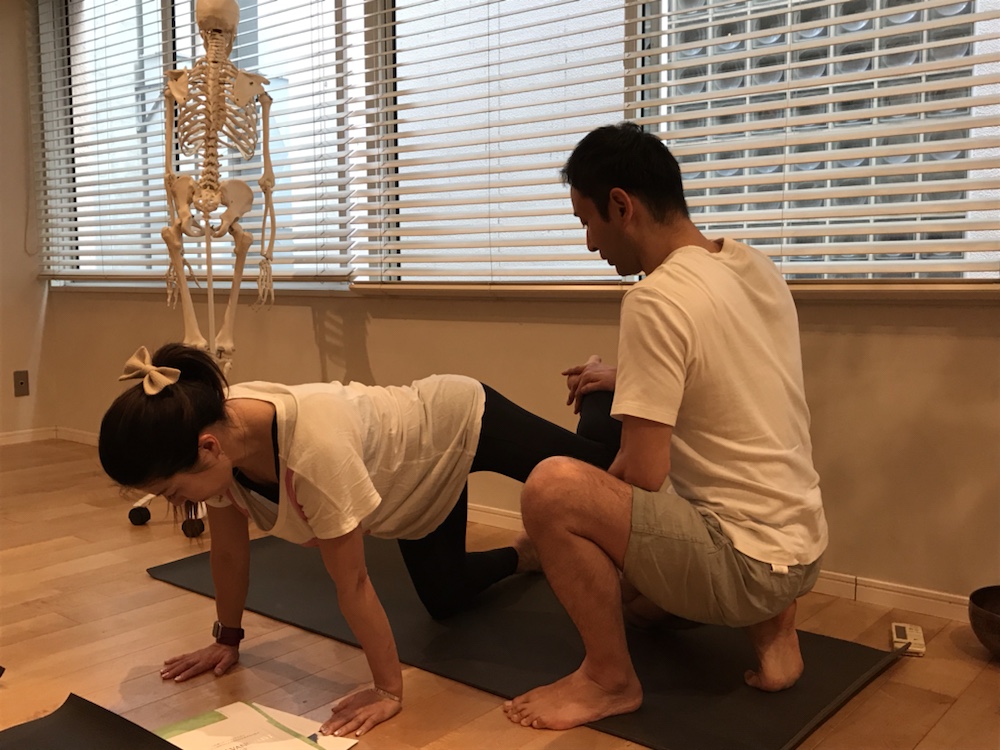
Mr. Nyui: "Next, is there anyone with back pain?"
A woman was chosen from the group and lay down on a mat.
Mr. Nyui: "Is your back pain pretty bad? Do you go to a chiropractor or anything?"
Female participant: "About once a week."
Mr. Nyui: "Oh dear. It's the same principle for back pain: use the muscles of the leg. Like this."
Push...

Mr. Nyui: "It also helps to loosen the piriformis, the muscle that runs out from both sides of the sacrum."
Push...
Mr. Nyui: "How does that feel?"
Female participant: "Wow! My back feels light! It's totally different!"
Mr. Nyui: "Great :) Now you can fix it yourself."
Both of them changed in an instant, which amazed us all, and then everyone paired up and tried it.
My forward fold went from just touching the floor with my fingertips to getting my palms flat on it, and I was shocked.
Personally, I thought being able to learn this anatomy and physiology is a big draw.
You wouldn't need to go to a chiropractor anymore, and you could help other people with their back pain too.
After that, we all meditated together. Mr. Nyui described meditation as a state of being "completely absorbed," where your concentration is at its peak.
I usually fall asleep during Shavasana (the pose where you lie on your back), so learning that meditation has benefits beyond relaxation was a real discovery.
After about two hours, I was given a copy of his book and we went our separate ways.
What Is the "RYT200" Yoga Teacher Certification?
You don't strictly need any qualification to be a yoga teacher, but to be a trusted one, I think it's reassuring to have some kind of certification.
They said you can get the RYT200 by completing a teacher training course, but I didn't really understand what that was, so I looked it up.
Yoga Alliance's "RYT" Certification
RYT is a yoga teacher credential created by Yoga Alliance.
There are several levels, depending on hours of training and so on.
It's pretty complicated, so feel free to skip this part (lol).

■RYT200 (Registered Yoga Teacher 200 hours)
- Complete a 200-hour training course at a Yoga Alliance registered school (RYS)
- No teaching hours or years of experience required
- Hours taken at several studios can't be combined
■RYT500 (Registered Yoga Teacher 500 hours)
- Complete a 500-hour course, or complete a 300-hour course after getting your RYT200
- The 200 and 300 hours can be completed at different registered schools and still be combined
- After completing training at an RYS200 or RYS500 school, at least 100 hours of teaching experience are required; years of experience don't matter
■E-RYT200 (Experienced Registered Yoga Teacher 200 hours)
- After getting your RYT200, you need at least 2 years and 1,000 hours of teaching experience
- Once registered with the Alliance, you can become a lead trainer for RYT200 courses
■E-RYT500 (Experienced Registered Yoga Teacher 500 hours)
- RYT500 holders need at least 4 years since getting their RYT200 and a total of 2,000 hours of teaching experience, of which 500 hours must come after the RYT500.
- Once registered with the Alliance, you can become a lead trainer for 200-, 300- and 500-hour courses

■RCYT (Registered Children's Yoga Teacher)
- For RYT200 or RYT500 holders who complete a 95-hour course at an RCYS (Registered Children's Yoga School)
- After the course, at least 30 hours of teaching kids' yoga. Years of experience don't matter.
■RPYT (Registered Prenatal Yoga Teacher)
- For RYT200 or RYT500 holders who complete 85 hours of training at an RPYS (Registered Prenatal Yoga School)
- After the course, at least 30 hours of teaching prenatal yoga. Years of experience don't matter.
The rules basically say you can't get the other credentials without the RYT200,
so it looks like everyone starts with the RYT200.
By the way, there's no national yoga qualification in Japan. The Japan Yoga Instructor Association (JYIA) seems to be the major one there: taking the Level 3 Master Course (38.5 hours), Level 2 Advanced Course (59.5 hours) and Level 1 Senior Course (60 hours) costs ¥565,000 in total (¥3,575 per hour).
If you pass the written exam, practical exam and interview, you get a JYIA license at that level.
Yoga Alliance
It's the world's best-known nonprofit yoga organization, founded in the United States in the 1980s.
Because it's recognized worldwide, Yoga Alliance works like an international license for yoga teachers.
The RYT programs have standards for class hours, content and instructors, and a school that passes the application becomes a registered school.
Registered schools are called RYS (Registered Yoga School) and you can search for them on the Yoga Alliance website, so I tried searching Tokyo.
There were 156 schools in Japan and 69 yoga studios in Tokyo. Fewer than I expected...!
And the only 5-star studio in Meguro-ku was Lila Yoga.

Yoga Studios in Meguro-ku Where You Can Get the RYT200
Finally, I compared the yoga studios in Meguro-ku where you can earn an RYT.
The RYT200 requires 200 hours, but some courses list fewer than 200 lecture hours, apparently because assignments and exams aren't counted as lecture time.
| Yoga studio | Actual lecture hours | Price |
| YOGA Studio & School "Lila Yoga Institute" | 50h+58h+115h=223h Includes 30 regular classes | ¥448,000 (tax included) |
| FLOW ARTS Yoga | 5h x 28 days = 140h Includes 30 regular classes | ¥460,000 (excl. tax) |
| Ohana Smile Yoga Studio | 8.5h x 20 days = 170h | ¥410,400 (tax included) |
Ohana Smile is the fastest route to certification, and the best value was Lila Yoga!
It depends on the studio, but regular classes are sometimes thrown in as a bonus, so if you're thinking of going to yoga regularly, the teacher training course seems like the better deal.
Right now, signing up for Lila Yoga's free group information session gets you one trial yoga class.
If you live near Gakugei-Daigaku, it could be a nice way to refresh yourself on an outing.